
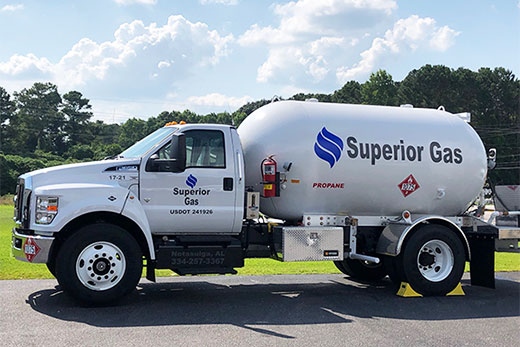
When it comes to propane delivery, we are Auburn’s top choice for fast, convenient, and safe service that you can count on. We appreciate the value of loyalty, which is why we go above and beyond to provide outstanding service and exceed our customers’ expectations. When you choose us, you can trust that you’ll receive prompt and reliable service that’s tailored to your unique needs and schedule. We live by the values our company was founded on: respect, hard work and always being there when our customers need us.
Our full-service approach means that we provide not only reliable propane delivery, but also the support and guidance you need to make informed decisions about your energy usage.
Trust us for all your home comfort needs – call us now to schedule your Delivery.
Address:
Superior Gas 24 Tallapoosa St, Notasulga, AL 36866
Phone:
1-334-257-3367
Hours:
Sunday: Closed
Monday: 8:00am – 5:00pm
Tuesday: 8:00am – 5:00pm
Wednesday: 8:00am – 5:00pm
Thursday: 8:00am – 5:00pm
Friday: 8:00am – 5:00pm
Saturday: Closed
Nestled in the heart of Alabama, Auburn’s story begins in 1836, founded by settlers from Georgia who were inspired by Oliver Goldsmith’s poem, naming it after the “sweet Auburn” he described.
Officially incorporated in 1839, the city soon became a beacon of learning as the home of the state’s first land-grant university, East Alabama Male College, established in 1859. This beloved institution, which would eventually become Auburn University in 1960, has always been at the heart of the city’s growth and spirit, weaving its legacy into the very fabric of the community.
The outbreak of the Civil War in 1861 brought troubles to Auburn. The schools closed their doors, and many businesses followed suit. The town had a hospital for Texan Confederate soldiers, only experiencing the war directly through raids in 1864 and 1865.
Following the war, Auburn faced a period of rebuilding that tested its resilience. The downtown area was scarred by fires. A turning point came in 1872 when the East Alabama Male College was given to the state, becoming the Alabama Agricultural and Mechanical College under the Morrill Act. With the Hatch Act of 1887, the college expanded its agricultural research, sowing seeds for future growth. A truly progressive step was taken in 1892 when the college became the first in Alabama to welcome women into its four-year programs.
This spirit of inclusion, combined with a growing interest in scientific agriculture and engineering, helped the community begin to flourish once more. By 1910, the town’s population had returned to its pre-war levels, and the success of the college’s football team brought a sense of pride and renewed energy to the city.
The community faced challenges again with the Great Depression, a time when the state couldn’t fund the college. The people of Auburn came together, relying on a barter economy to support one another.
A new chapter began with the start of World War II, as Auburn’s campus transformed into a training ground for the armed forces. After the war, the town was filled with soldiers returning to continue their education on the G.I. Bill, ready to build a brighter future.
Auburn made a bold strategic move in the 1980s, aggressively pursuing industry development that delivered remarkable results with a nearly 1,200% increase in industrial jobs over the next twenty years. What truly sets Auburn apart is its exceptional school system, consistently ranked among the top in both the state and nation. This proven track record convinced thousands of families to choose Auburn as their home throughout the late 20th and early 21st centuries. The numbers speak for themselves: between 1980 and 2003, Auburn’s population surged by 65%, while the economy expanded by an impressive 220%.
Notable natives and residents of Auburn include:
Octavia Spencer, actress who won the Academy Award for Best Supporting Actress for her performance in the 2011 film The Help. Other films she has performed in include Hidden Figures, Fruitvale Station, Self Made, and The Shape of Water.
Frederick Chapman Robbins, a pediatrician and virologist who won the Nobel Prize in Physiology or Medicine alongside John Franklin Enders and Thomas Huckle Weller. Their groundbreaking work in isolating and growing the poliovirus in tissue culture opened the door to life-saving polio vaccines later developed by Jonas Salk and Albert Sabin.
Jimmy Buffett, singer-songwriter who created a niche in popular music, tropical rock, focused on island escapism. He used this persona to create a business empire including his Margaritaville restaurant chain, and ventures in liquor, hotels, retirement communities, and casinos.
Tommy Tuberville, former Auburn University football coach now serving as a U.S. Senator for Alabama.
Bo Jackson, who played both football and baseball at Auburn University, then went on to play in both Major League Baseball and the National Football League, becoming the first athlete to achieve All-Star status in two major sports leagues. His “Bo Knows” ads for Nike were popular, and included athletes and celebrities including Michael Jordan, Wayne Gretzky, John McEnroe, and Bo Diddley.
Anne Rivers Siddons, author of Southern Gothic novels such as Peachtree Road, The House Next Door, and Fox’s Earth.
Toni Tennille, singer for the duo Captain & Tennille, best known for 70s hits Love Will Keep Us Together and Muskrat Love.